Here is a statistic that surprises most people: roughly 77% of property investors in New Zealand own just one rental property. Not two, not five - one. And the reason most of them stop at one has very little to do with ambition, market knowledge, or even having enough equity for another deposit. The barrier is almost always income servicing. Banks will not lend you money for a second investment property if the numbers do not stack up on their affordability model, and their model is considerably more conservative than most investors expect.
How Banks Actually Assess Your Borrowing Capacity
When you apply for a mortgage on an investment property, the bank does not care what your actual repayments will be at today's interest rate. Instead, they stress-test the loan at a much higher theoretical rate - typically around 8.5% to 9% as of early 2025, depending on the lender. This is called the "test rate" or "serviceability rate" and it exists to make sure you could still afford your repayments if rates climbed sharply. On top of that, investment mortgages are usually assessed over a 25-year term rather than 30, which pushes the theoretical repayments even higher.
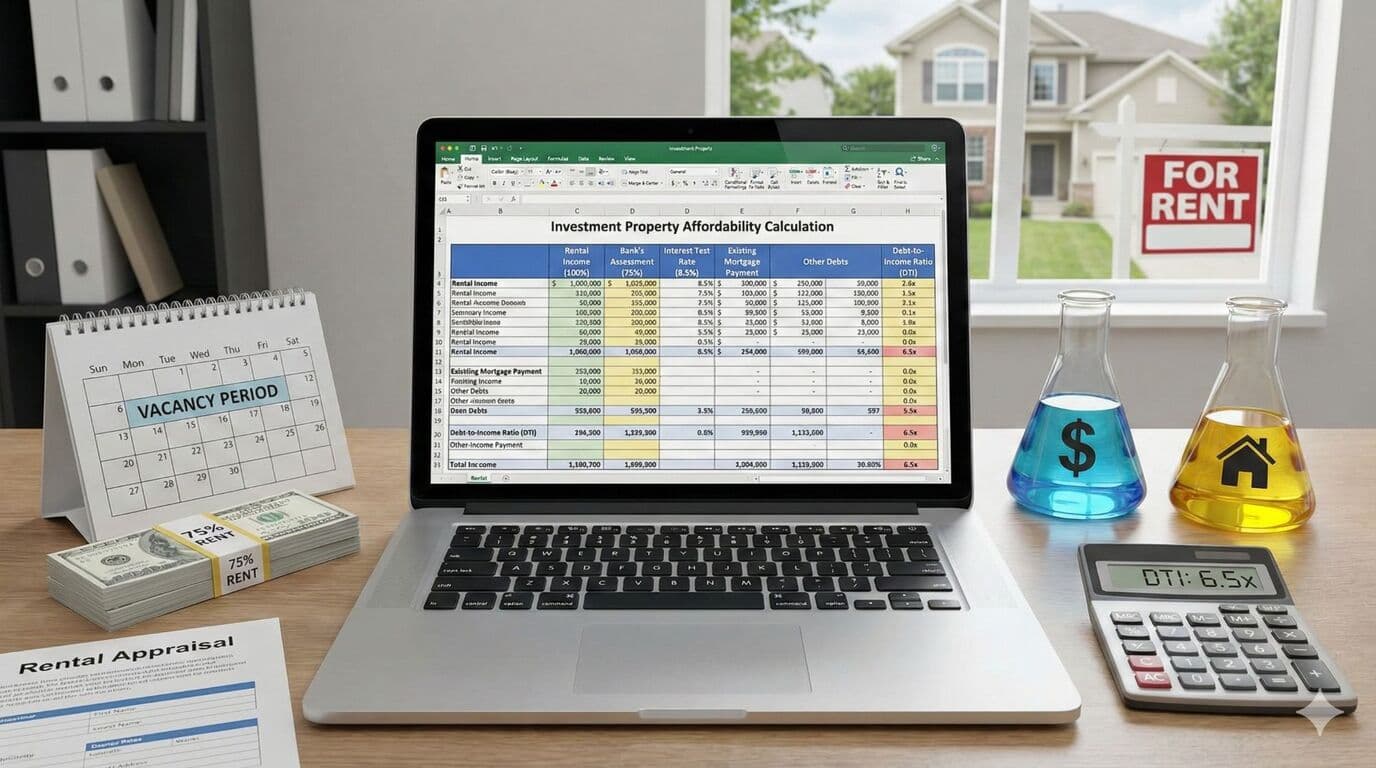
The way rental income is treated makes things worse. Banks will only count about 75% of your rental income in their calculations, to allow for vacancies, maintenance, and periods where the property might be empty between tenants. So if your rental brings in $600 per week, the bank only counts $450 for servicing purposes. Meanwhile, every dollar of existing debt counts against you at full value. Your car loan repayments, your personal loan, your existing mortgage - all of these reduce the income available to service a new loan.
The Credit Card Trap
One of the most underappreciated drags on borrowing capacity is credit cards. Banks do not look at what you owe on your credit card - they look at your total credit limit and assume you could max it out at any time. A credit card with a $10,000 limit reduces your borrowing capacity by roughly $40,000 to $50,000, even if you pay it off in full every month and have never carried a balance. If you and your partner both have $15,000 credit cards, that is potentially $100,000 of borrowing capacity evaporating before you have even started the application. Cancelling or reducing unnecessary credit card limits before applying is one of the simplest and most effective things an aspiring property investor can do.
Why the Second Property Is Harder Than the First
Your owner-occupied home mortgage usually gets assessed at a 30-year term with the full household income supporting it. When you add an investment property, the dynamics shift. The new mortgage gets the shorter 25-year assessment, the rental income gets haircut to 75%, and suddenly the bank's model shows your total commitments eating up most of your income. Even if you have $200,000 in usable equity and a property in mind that would be positively geared from day one, the bank may still say no because their theoretical stress-test scenario shows you would struggle.
This is why so many investors get stuck at one property despite having the equity, the knowledge, and the motivation to grow their portfolio. The income hurdle is real, and it catches people off guard because they focus on deposit and equity when the actual constraint is servicing.
Practical Ways to Improve Your Position
The most impactful thing you can do is reduce your non-mortgage debt. Clearing a $20,000 car loan does not just save you the repayment amount - it frees up that entire repayment in the bank's servicing model, which can translate to $80,000 or more in additional borrowing capacity. Similarly, closing credit cards you do not need provides an immediate and significant boost.
Increasing your income is the other big lever. Even a relatively modest pay rise makes a meaningful difference in bank calculations. A $5,000 annual salary increase might unlock $40,000 to $50,000 in additional borrowing capacity. If you are self-employed, making sure your financials accurately reflect your true earning capacity is critical - banks rely heavily on your last two years of financial statements, so if you have been aggressively minimising taxable income, that strategy may be costing you more in lost borrowing capacity than it saves in tax.
Targeting cashflow-positive properties also helps, because any surplus rental income after expenses flows through to improve your overall servicing position. A property that generates $100 per week above its costs is not just a good investment in its own right - it actively makes it easier to buy the next one. This is why experienced investors often favour higher-yielding regional properties over premium Auckland suburbs where rental yields are thin.
Getting the Structure Right Early
If you are serious about building a portfolio beyond one property, talk to a mortgage adviser before you buy your first investment property - not after. The way you structure your lending, the order you acquire properties, and even which bank you go with can make a significant difference to how far you can scale. Some banks are more favourable to investors than others, and a good adviser will know which lenders are most likely to approve your second and third purchases based on your specific income and debt profile.
Need Help With Your Mortgage?
Our expert advisers are here to guide you through every step of your mortgage journey. Get in touch for a free, no-obligation consultation.
Talk to an Adviser