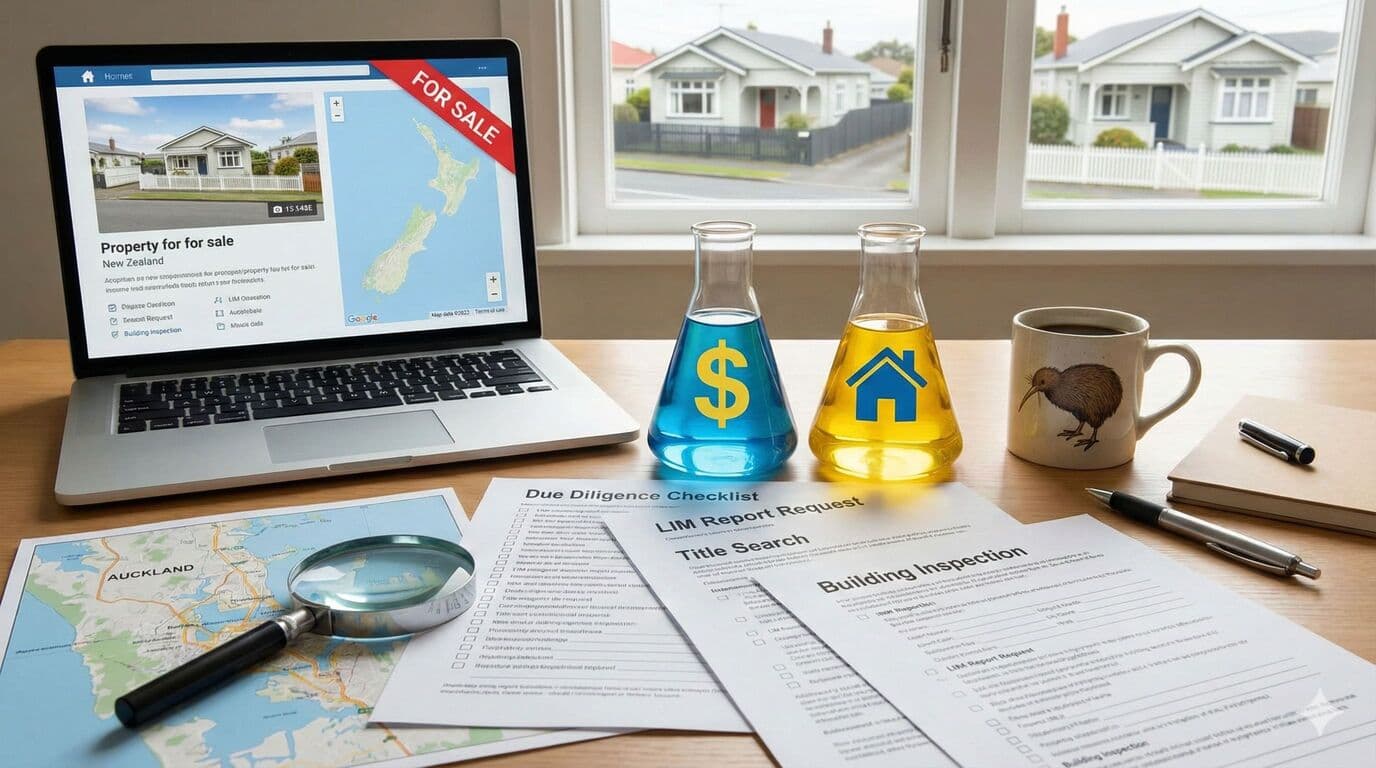
Buying a home in New Zealand is probably the biggest financial commitment you will ever make, and the due diligence you do before signing the sale and purchase agreement can save you from some seriously expensive surprises. Too many buyers get caught up in the excitement of finding a place they love and skip steps that would have revealed major problems. Here is what you actually need to check, what it costs, and why each piece matters.
Title Search and Legal Review
Before you do anything else, your solicitor needs to pull the title and go through it with a fine-tooth comb. The title tells you who legally owns the property, what type of ownership it is (freehold, cross-lease, or unit title), and whether there are any encumbrances registered against it. Easements are common - they might give a neighbour the right to use your driveway or allow a utility company to run pipes across your land. Covenants can restrict what you are allowed to build or how you can use the property. None of these are necessarily deal-breakers, but you need to know about them before you commit.
Cross-lease and unit title properties come with extra complications. With a cross-lease, you technically own a share of the land and lease your specific area, which means you often need your neighbour's consent for alterations. Unit titles involve a body corporate with its own rules, levies, and long-term maintenance plans. A title search costs around $20 to $50 through your solicitor and it is money extremely well spent.
The LIM Report
The Land Information Memorandum, or LIM, is a report from the local council that pulls together everything they know about the property. It covers building consents and whether they received a Code Compliance Certificate, the property's zoning, flood risk, land stability issues, stormwater and sewage arrangements, heritage status, and current rates. A LIM costs between $200 and $400 depending on the council - Auckland is at the higher end around $350, while smaller councils are cheaper. Allow 10 to 15 working days for processing, though most councils offer an urgent option for an extra fee.
The single biggest red flag in a LIM is unconsented building work. If someone added a bedroom, a deck, or a sleep-out without getting council consent, you inherit that problem. The council can require you to bring the work up to code or even remove it. Flood zone designations, contaminated land notations, and notes about land instability are also things you need to take seriously and discuss with your solicitor before going any further.
The Property File
The property file is a separate document from the LIM and it contains the full historical record of everything the council holds on the property - original building plans, consent applications, inspection notes, and any correspondence. It costs $30 to $50 and can reveal details that the LIM only summarises. If you see failed inspections or incomplete consent processes in the property file, that warrants further investigation with your solicitor and possibly a specialist building inspector.
Building Inspection
A professional building inspection is not optional, even on newer properties. A good inspector will assess the structural integrity, weathertightness, moisture levels in the walls and floors, plumbing, electrical systems, roof condition, subfloor ventilation and piles, and insulation. They use moisture meters and thermal imaging to find problems invisible to the naked eye. Expect to pay $400 to $800 depending on the size and complexity of the property, with larger or multi-building properties costing more.
The inspector will give you a written report with photos, usually categorised by severity, and most will walk you through the findings over the phone. For some properties, you may need specialist reports on top of the standard inspection. Meth testing runs from $30 for a basic screening kit up to $300 for a comprehensive lab test. Asbestos testing costs $100 to $200 per sample. If the building inspector flags structural concerns, an engineering report could set you back $500 to $2,000, and a geotechnical report for land stability issues ranges from $1,000 to $3,000. These are significant costs, but they pale next to the cost of buying a property with a major hidden defect.
Valuation
A registered valuation gives you an independent opinion of the property's market value. Banks require one if you are borrowing with less than 20% deposit, but even if you are not in that category, a valuation provides useful reassurance that you are not overpaying. Registered valuations cost $600 to $1,000, and sometimes the bank will cover this as part of your mortgage application. Your mortgage adviser can tell you whether the bank will arrange and pay for the valuation or whether you need to organise it yourself.
Units and Apartments
If you are buying a unit title property, there is a whole extra layer of due diligence on top of the standard checks. Ask for the body corporate meeting minutes from the last two to three years and read them carefully - they will tell you about any disputes, upcoming maintenance, and the financial health of the body corporate. Check the long-term maintenance plan to see what major work is scheduled and how it will be funded. Review the financial statements to make sure reserves are adequate. The seller is legally required to provide a pre-contract disclosure statement summarising all of this, but do your own reading rather than taking it at face value. Body corporate levies can be substantial - anywhere from $3,000 to $15,000 or more per year for larger complexes - and you need to factor these into your affordability calculations alongside your mortgage, rates, and insurance.
Natural Hazards and Insurance
New Zealand sits on an active fault line and has a varied geography that creates property-specific risks you need to understand before buying. Check whether the property has any previous EQC claims, especially in Christchurch and Wellington where earthquake damage history is particularly relevant. Look at the council's flood maps and ask the neighbours whether the area has ever flooded - locals often know things that do not show up in official records. Coastal properties may face erosion risk, and hillside homes can be prone to slips in heavy rain.
All of these hazard factors feed into whether you can get house insurance and what it will cost. Contact insurers early in your due diligence process, because some properties in high-risk areas or with weathertightness issues are genuinely difficult or very expensive to insure. If you cannot get reasonable insurance cover, most banks will not lend on the property either, so this is not something you can leave until settlement day.
Your Professional Team
Get your property experts lined up before you start making offers. You need a solicitor to handle the legal review and manage the purchase process, a building inspector you trust, a mortgage adviser to confirm your borrowing capacity and manage the finance condition, and ideally an insurance broker who can check availability and pricing early. Do not rely on the real estate agent for advice on any of these matters - their job is to sell the property and their primary obligation is to the vendor, not to you.
Budget and Timeline
In total, comprehensive due diligence costs somewhere between $1,250 and $2,600, depending on how many specialist reports you need. When you are buying a property worth $600,000 or more, that is a tiny fraction of the purchase price and well worth every dollar. Make sure your conditional offer allows enough time for everything - 10 to 15 working days is standard for finance and building inspection conditions, and you should talk to your solicitor about timing before you put an offer in.
The properties that cause the most grief are the ones where buyers cut corners to save a few hundred dollars on due diligence, or waived conditions to make their offer more competitive. Every experienced solicitor has stories of buyers who wished they had spent the money upfront. Do the homework, trust your professionals, and go into the purchase with your eyes wide open.
Need Help With Your Mortgage?
Our expert advisers are here to guide you through every step of your mortgage journey. Get in touch for a free, no-obligation consultation.
Talk to an Adviser