Ready To Buy: 5 Things Investment Property Buyers Can Do To Get Ready
Buying your first investment property can feel like stepping into the unknown, but it's not your first rodeo. Most investors have already been through the process of buying a home before. So while buying your first house might have felt like stumbling around in the dark, buying your first rental property is more like walking through a dimly lit room. You can see the shapes, but you still want a torch.
The good news is, with investment properties, you generally need a decent deposit or equity buffer (typically 30-35% for existing properties, though this can be as low as 20% for new builds), which can make things feel a bit more secure than borrowing 90% for your first home. If you're serious about investing in property, here are five smart steps you can take today to get ready.
1. Define Your Goals and Strategy
Before you start browsing Trade Me Property at 11pm on a Tuesday, you need to be crystal clear about why you're doing this. Investment property isn't an emotional decision like buying your first home, it's a business decision. So think with your head, not your heart.
What are you actually trying to achieve?
Most property investors fall into one of two camps: those chasing capital growth and those focused on rental yield. Capital growth investors buy in areas where property values are likely to increase significantly, with the goal of selling for a profit down the track. They're often willing to accept lower rental returns in exchange for stronger long-term appreciation. Rental yield investors, on the other hand, want steady income from rent that covers (or at least significantly contributes to) their mortgage repayments and costs. Of course, plenty of investors want a mix of both, accepting lower yields in high-growth areas while still generating some income along the way.
Your timeline matters just as much as your strategy. Are you planning to retire in 10 years and want the rental income to supplement your retirement? Or are you building a portfolio to pass down to your kids? Your long-term plan will influence what type of property you buy and where.
Think strategically, not emotionally. You might love character villas with original features, but if they're expensive to maintain and appeal to a narrow tenant market, they might not be the smartest investment. Similarly, you don't need to buy in your favourite suburb, you need to buy where the numbers work and the rental demand is strong.
The most successful property investors treat it like a business from day one. They have a plan, they stick to it, and they don't get swept up in auction fever or fall in love with a property that doesn't meet their criteria.
2. Get Your Finances Sorted (And Your Team Assembled)
This is where the rubber meets the road. You need to know exactly where you stand financially before you start seriously looking at properties.
Review your budget honestly
Look at your current income, expenses, debts, and savings. Can you comfortably afford to take on an investment property? And critically, can you cover the costs if the property sits vacant for a few months, or if you need to pay for unexpected repairs?
Investment properties come with ongoing costs beyond just the mortgage. You'll need to budget for property insurance, council rates, maintenance and repairs, and potentially property management fees if you're not managing it yourself (typically 7-10% of rental income). Then there are the periods of vacancy between tenants, which can hit you harder than you might expect. A lot of investors keep an additional buffer of around $20,000 in an offset account specifically for these "what if" scenarios. It's insurance against the unexpected, and it lets you sleep better at night.
Build your professional team
You're going to need help from people who know what they're doing:
A mortgage adviser or broker: They'll help you understand your borrowing power, structure your lending properly, and potentially save you thousands by finding better rates or structures than you'd get walking into a bank on your own.
A property accountant: This is non-negotiable. Tax rules around investment property have changed significantly over the past few years, and you need specialist advice. A good property accountant will help you figure out the most tax-efficient ownership structure for your situation (personal name, trust, Look Through Company, etc.) and ensure you're claiming everything you're entitled to while staying completely above board.
A lawyer or conveyancer: They'll handle the legal side of the purchase and make sure your offer protects your interests.
Optional but valuable: A property manager (if you don't want to be a hands-on landlord) and potentially a financial adviser to ensure property investment fits sensibly into your broader financial picture.
Understand ownership structures
This deserves its own section because it's important and often misunderstood.
Back in the day, Look Through Companies (LTCs) were the go-to structure for investment properties, especially because they allowed you to pass losses through to your personal tax return. But the rules have changed substantially in recent years, and an LTC might not be the best choice for everyone anymore.
Whether an LTC still makes sense for you depends on several factors. Are you relying on losses for cashflow? How long do you plan to hold the property? Would moving the property into an LTC trigger issues under the bright-line test (more on that below)? What's your long-term tax situation? These questions all matter, and the answers are different for everyone.
Don't guess. Start by talking to an investment-savvy accountant before you buy. They'll ask the right questions about your situation and help you figure out whether an LTC makes sense or whether you're better off with a different structure. Getting clear advice early means you won't need to restructure things later on, which can be expensive and complicated.
Secure financing pre-approval
Talk to a mortgage adviser and find out exactly what your borrowing limits are. You don't want to spend weeks browsing $800,000 properties if you can only afford $600,000.
A good adviser can help you figure out whether your limitations are around income, equity, or something else like your credit history. And if you're close to your borrowing limit, they can often suggest small tweaks that make a significant difference.
For investment properties, you'll typically need a 30-35% deposit for existing properties or a 20% deposit for new builds. Alternatively, you can use equity from your existing home to fund the purchase without needing to save up a full cash deposit.
Using equity from your current home
If you already own a property, you might not need to save up a full cash deposit for your investment property. Instead, you might be able to use some of the equity in your home.
Equity is simply the difference between what your property is worth and what you owe on it.
For example, if your home is worth $900,000 and your remaining mortgage is $500,000, you have $400,000 in equity.
You can't use all of it though. Lenders generally require you to keep a minimum level of equity in your existing properties, usually at least 20% in your home and 30% in any investment properties you already own.
So in the example above, with a $900,000 home, you'd need to keep at least $180,000 in equity (20%), which means you could potentially use up to $220,000 of your equity towards purchasing an investment property.
Here's how to calculate your usable equity: Start by finding out your home's current market value, then check your remaining home loan balance. Subtract your loan balance from your home's value to get your total equity. Keep in mind that you must maintain at least 20% equity in your owner-occupied home, which limits how much you can actually use.
If you own multiple properties, you might be able to combine equity across them, as long as you meet your lender's criteria.
A word of caution: Using equity gives you more financial flexibility, but you need to understand the risks. You're essentially increasing the debt against your home. If property values drop or interest rates rise significantly, you need to be confident you can still manage the additional debt. While saving a cash deposit takes longer, it leaves your home's equity intact, which might offer more security for some people.
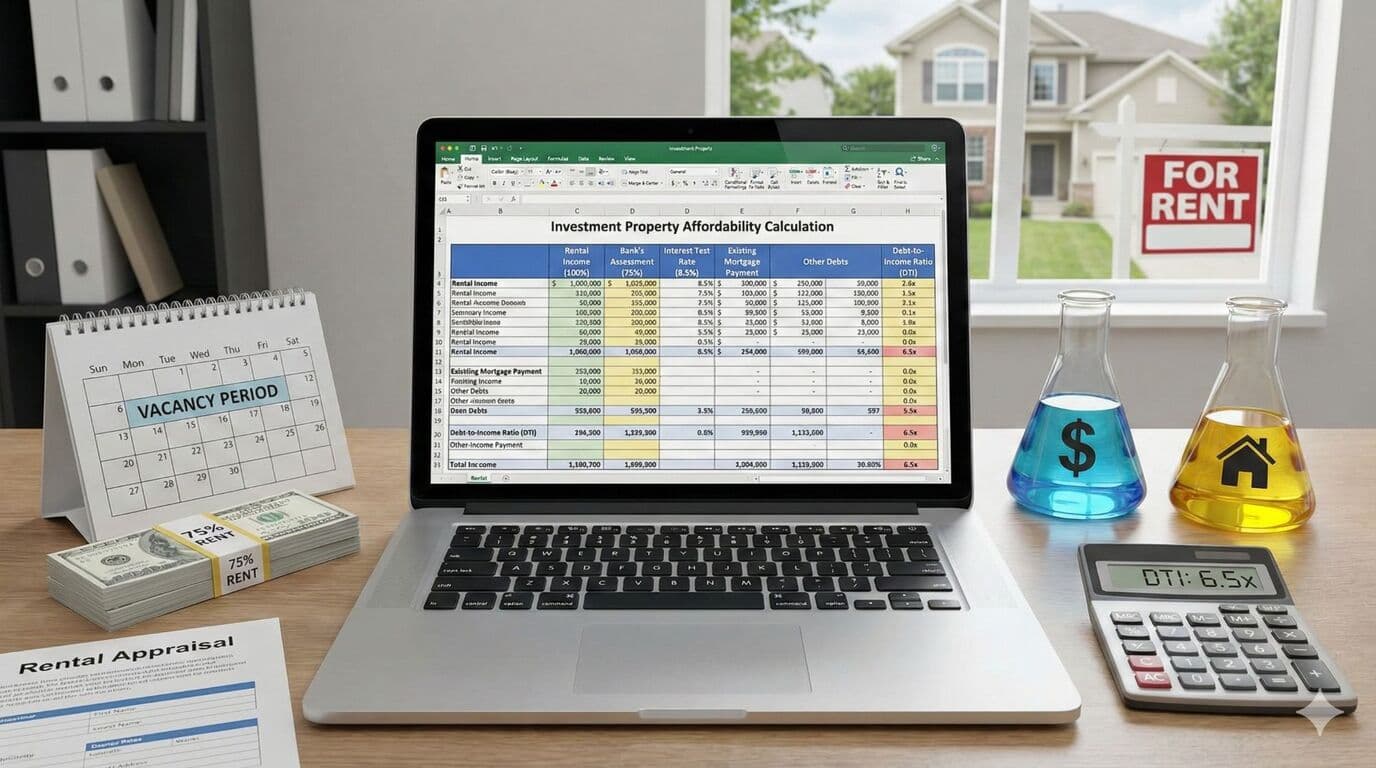
Run the numbers (seriously, get a spreadsheet going)
Investment property is a numbers game, and your comfort with risk plays a big part in how much you should borrow.
It's common to feel daunted by a new $500,000 mortgage when the rent only adds $30,000 to your annual income. But remember: with more debt comes more income potential, and banks already stress-test your mortgage affordability using interest rates of around 6-8%, even if current rates are lower.
Try this: Create a spreadsheet and run some "what if" scenarios:
What if your tenant leaves and the place sits vacant for three months?
What happens if interest rates climb to 7%? Can you still manage the payments?
What if you need to replace the hot water cylinder or fix the roof?
Running these scenarios now will give you more confidence when you're ready to make an offer. You'll know your actual comfort zone, not just what the bank says you can borrow.
Don't forget insurance
If you're about to add more debt to your life, it's time to review your insurance. Life and health cover become even more important when you've got extra financial responsibilities. We don't offer insurance ourselves, but we work alongside advisers who do. The best ones will take the time to understand your situation, compare multiple policies, and recommend the cover that fits you best.
3. Research Properties and Markets (Location, Location, Numbers)
Once you've got your finances sorted and your team assembled, it's time to start looking at actual properties. But don't just start attending open homes at random, do your homework first.
Location is absolutely key
The best investment locations share several characteristics. Strong population growth means more people moving to an area, which translates to more rental demand. Good job opportunities matter because tenants need employment to pay rent. Proximity to amenities like public transport, schools, shops, cafes, and restaurants all make a location more attractive to renters. Watch for infrastructure development too, new motorways, rail links, or commercial developments can signal future growth and increased property values.
Understand market trends
Research local market conditions before you commit. What are historical price trends in the area? What are average rental rates for the type of property you're considering? Is there strong demand for rentals, or is the market oversupplied? What's the typical occupancy rate, and how long do properties sit vacant between tenants? These questions all have answers if you're willing to do the homework.
Websites like QV.co.nz have rental analysis tables where you can search median rents, annual rent changes, and gross rental yields for different suburbs around the country.
Rental yield is the rent a property could earn over a year, expressed as a percentage of the property's value. The basic equation is: annual rental income divided by property value, multiplied by 100.
For example, if a property costs $600,000 and generates $28,000 in annual rent, your gross rental yield is 4.67%.
Think about the property itself
When you're evaluating specific properties, focus on:
Appeal to a wide range of tenants: Properties that suit different types of renters (families, couples, professionals) are easier to keep tenanted. Three-bedroom homes in good school zones are often a safe bet.
Low maintenance: Older character homes might look beautiful, but they can be expensive to maintain. Consider how much ongoing work the property will need.
Healthy Homes Standards: In New Zealand, all rental properties must meet minimum standards for heating, insulation, and ventilation. If a property doesn't meet these standards, you'll need to factor in the cost of upgrades before you can legally rent it out.
Condition and maintenance requirements: Get a professional building inspection. What looks like a cosmetic issue might actually be a major structural problem. Factor in realistic maintenance costs, older properties generally need more upkeep than newer ones.
For townhouses or apartments, remember that you'll typically have body corporate fees or levies to pay on top of your other costs.
Perform proper due diligence
Before you commit to any property, get a professional building inspection and request a property valuation (your lender will likely require this anyway). Check the LIM (Land Information Memorandum) for any council issues, zoning restrictions, or planned developments that might affect the property's value or usability. If it's currently a rental, ask to see rental history, how much it's been renting for, and what the occupancy rate has been like. Don't skip these steps to save a few hundred dollars. Finding out about a $30,000 drainage problem after you've signed is a very expensive lesson.
4. Understand Tax and Legal Obligations
Property investment has significant tax implications, and the rules have changed considerably in recent years. You absolutely need professional advice here, but here are the basics you should understand:
Income tax on rental income
You must pay income tax on your net rental income (rent minus allowable expenses). Allowable expenses typically include interest on your mortgage (though recent rule changes have affected interest deductibility, your accountant will explain the current position), rates and insurance, property management fees, maintenance and repairs, and depreciation on chattels like furniture and appliances.
Ownership structure matters
Your property accountant can advise on the most tax-efficient ownership structure for your situation. Personal name ownership is simple but offers no asset protection. A trust can provide asset protection and estate planning benefits. A Look Through Company (LTC) may provide tax benefits depending on your circumstances, but the rules have changed significantly in recent years. The right structure depends on your personal tax position, your long-term goals, and your risk profile. This isn't a DIY decision.
Ongoing compliance
As a landlord, you'll need to keep detailed records of all income and expenses, file an IR3 individual tax return (or IR6 if your property is owned by a company) each year, understand and comply with the Residential Tenancies Act, meet Healthy Homes Standards, and respect tenant privacy by following proper processes for inspections, rent increases, and ending tenancies. Tenancy Services (tenancy.govt.nz) has comprehensive information about landlord obligations and the laws that apply to rental properties.
5. Decide How You'll Manage the Property
Finally, you need to decide whether you're going to manage the property yourself or hire a professional property manager.
Self-management
Managing your own property means you save 7-10% of rental income in management fees, you have direct control over tenant selection and property decisions, and you build relationships with your tenants. However, it's also time-consuming. You'll be handling advertising, tenant vetting, inspections, maintenance coordination, and rent collection. You're on call for emergencies and repairs, you need to understand and comply with all tenancy laws, and dealing with difficult tenants or disputes can be genuinely stressful.
Professional property management
With professional management, they handle everything from finding tenants to collecting rent, arranging maintenance, and conducting inspections. They know the Residential Tenancies Act inside out, they provide a buffer between you and the tenant, and you can be a more passive investor. The downside is that management fees typically run 7-10% of rental income (plus letting fees for finding new tenants), you have less direct control over day-to-day decisions, and not all property managers are equally good. Choosing the right one matters.
Many first-time investors start with professional management to learn the ropes, then decide later whether to take over themselves once they're more confident.
Why Invest in Property? The Potential Benefits
Before we wrap up, let's talk about why people invest in property in the first place. Rental income can cover your mortgage repayments (or at least a significant portion of them), meaning someone else is essentially paying off your asset. Historically, New Zealand property has increased in value over the long term, and while past performance doesn't guarantee future results, many investors build substantial wealth through property appreciation. Unlike shares or managed funds, property is physical. You can see it, touch it, improve it. For many people, this feels more secure. Property also allows you to use the bank's money to buy an asset that you control. Where else can you borrow $500,000 at 5-6% interest to invest in something with the potential to grow at 5-10% per year? Rental properties can provide cashflow in retirement, supplement your KiwiSaver, or be sold to fund your retirement years. Property can be passed down to children or grandchildren, providing financial security for future generations. And while the rules have tightened, many expenses associated with rental properties are tax-deductible, which can improve your overall returns.
The Risks You Need to Understand
It's not all sunshine and passive income. Property investment comes with real risks. Unexpected expenses like maintenance, wear and tear, broken appliances, and leaking roofs happen, often at the worst possible time. You need cash reserves to handle this. Your property might sit empty between tenants, and you need to be able to cover the full mortgage and costs with no rental income coming in. If interest rates rise significantly, your repayments will increase too. Have you stress-tested your budget for this? Property values can go down as well as up, and if you need to sell during a downturn, you might make a loss. Property isn't like shares either, you can't sell it instantly if you need cash. Selling takes time and costs money in agent fees, legal costs, and marketing. Difficult tenants who damage property, don't pay rent, or cause problems can be stressful and expensive to deal with. Government policies around property investment (interest deductibility, bright-line test, Healthy Homes Standards) can change and impact your returns. And if property is your only investment, you're not diversified. A downturn in the property market affects your entire wealth.
The Reality: Pros and Cons at a Glance
Here's a honest look at both sides:
Advantages:
Potential for rental income that could cover mortgage repayments or a large part of them
Some expenses may be deductible against your taxable rental income
Potential for capital gains as property values increase
Ability to use equity in your existing property to fund your investment
It's a tangible, "bricks and mortar" investment
Can provide cashflow to help fund retirement
Leave a nest egg for your family
Risks:
Unexpected expenses (maintenance, vacancy, insurance increases, rate rises)
Interest rates could rise, increasing costs and reducing profit
Initially there may be little or no profit after expenses (property investment is often about long-term gains)
Complex tax rules around capital gains (always speak to a tax adviser)
Property values may not increase depending on the market
Selling takes time and you could make a loss
With increased debt against your home, changes in circumstances may make it harder to repay loans
Being a landlord comes with legal obligations and potential stress
If you're unsure about the tax treatment of investing in residential property, you absolutely should seek advice from a tax professional before proceeding.
Can You Actually Afford It?
Property investment might cost less than you think, but crunching the numbers is essential. Calculate your budget by working out how much equity you have in your existing home, how much money you have saved, all the costs involved with investing (deposit, legal fees, inspections, insurance, rates, maintenance, management fees), how much you need to borrow, and what rental income you could realistically receive for a property within your price range.
Don't forget about ongoing costs when working out affordability. You'll be dealing with loan interest (including any low equity margins), property management fees if applicable, property insurance, personal insurance (life, health, income protection), repairs and maintenance, council rates, body corporate fees for apartments or townhouses, and potential vacancy periods. All of these need to fit comfortably in your budget.
Your Next Steps
If you're serious about buying an investment property, today's a great day to speak with a property accountant and find out what ownership structure is best for you, start running the numbers to understand your risk profile and what you can actually afford, talk to a mortgage adviser and get clear on your borrowing power and equity position, research markets and properties that align with your goals and budget, and build your professional team of lawyer, accountant, and potentially property manager.
And remember, you don't need to do it all alone. The most successful property investors aren't the ones who know everything, they're the ones who know when to ask for help.
Investment property can be a genuine wealth-building tool, but it's not a passive, set-and-forget investment. It requires planning, ongoing management, and realistic expectations. Done well, it can provide financial security for you and your family for decades to come.
Mortgage Lab’s mission is to be the digital town square for financial decision-makers to gain knowledge about their current and future mortgage. Follow us on Facebook and LinkedIn or subscribe to our newsletter to be notified of our latest articles.