Buying an investment property in New Zealand is more complex than purchasing your family home. Banks apply stricter criteria, you need larger deposits, and the numbers must stack up differently. This guide covers everything you need to know before making your first-or next-investment property purchase.
Deposit Requirements: The Current Rules
Investment property lending has stricter LVR treatment than owner-occupied lending. Under current Reserve Bank LVR settings, investor high-LVR lending is lending above 70% LVR, and banks are limited in how much of that lending they can write.
In plain English, many investors should plan around a 30% deposit for an existing investment property. Some lenders may want more depending on the property, income, credit profile, and wider risk. New builds and some construction lending can sit outside the standard LVR speed limits, but that does not mean every new build is automatically approved on a tiny deposit. Lender policy still matters.
To put this in practical terms, consider a $700,000 investment property. A 30% deposit is $210,000. A new-build or construction scenario may be assessed differently, but the bank will still test your income, debt, expenses, DTI position, property type, and exit risk.
Using Home Equity as Your Deposit
Most NZ investors fund their deposit using existing home equity rather than cash savings. Banks typically lend up to 80% of your home value, so your usable equity is the difference between this amount and your current mortgage.
The calculation is straightforward: take your home value, multiply by 80%, then subtract your current mortgage. For example, if your home is worth $900,000 and you owe $450,000, your usable equity is $270,000. This amount could serve as the deposit for an investment property purchase.
There are two main ways to access this equity. The first is topping up your existing mortgage, where your current lender simply adds the deposit amount to your home loan. This approach is straightforward but increases your home loan balance. The second option is cross-collateralisation, where both properties secure a single lending arrangement. This is more complex, and problems with one property could affect both. Most advisers recommend keeping properties with separate banks where possible to maintain flexibility and reduce cross-default risk.
How Banks Assess Your Income
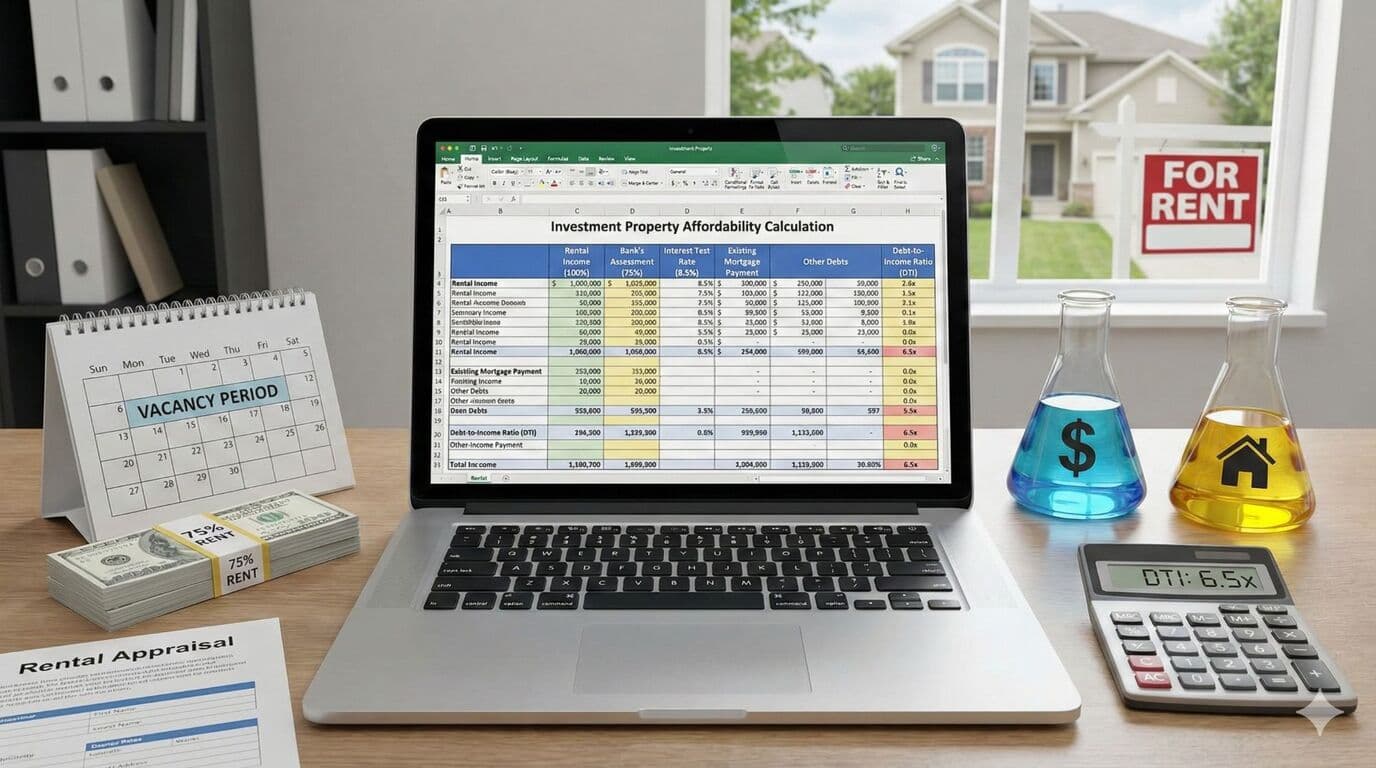
Banks apply conservative assumptions when assessing investment property lending. They do not count 100% of expected rent-typically including only 65-80% of rental income in their calculations. This discount accounts for vacancy periods (assumed at 3-4 weeks per year), maintenance and repairs, property management fees if applicable, and rates, insurance, and other expenses. A property renting for $600 per week ($31,200 annually) might only count as $20,280-24,960 in the bank's assessment.
Banks also stress test your ability to afford repayments at rates around 7-7.5% rather than the actual rate you will pay. This significantly reduces borrowing capacity compared to simple calculations based on current rates.
Since July 2024, debt-to-income (DTI) restrictions have affected how much high-DTI investor lending banks can write. A DTI of 7 is an important benchmark for investor lending, but it works as a bank portfolio restriction rather than a simple guaranteed personal borrowing cap. New build lending has different treatment under the DTI framework, though normal serviceability checks still apply.
Quick Affordability Test
A simplified formula can help you estimate whether you can afford an investment property. Multiply your household income by 5, then multiply expected rental income by 7. Your combined total should exceed your proposed combined mortgage debt. For example, a household earning $120,000 with expected rent of $30,000 per year would have a combined capacity of $810,000. If your combined home and investment mortgages would exceed this amount, you may struggle to get approval.
Reality check
Regional Yield Guidance
Rental yields vary significantly by location. Higher yields often come with lower capital growth potential, and vice versa:
| Region | Typical Gross Yield | Capital Growth Potential |
|---|---|---|
| Auckland | 3-4% | Moderate to strong |
| Wellington | 3.5-4.5% | Moderate |
| Christchurch | 4-5% | Moderate |
| Hamilton/Tauranga | 4-5% | Moderate |
| Regional cities | 5-7%+ | Lower |
| Invercargill, Rotorua | 6-8%+ | Lower |
Properties returning 5%+ gross yield are more likely to be cashflow neutral or positive, though net yield after all expenses is what truly matters.
Additional Costs to Budget For
Before committing to an investment property, you need to budget carefully for ongoing costs beyond the mortgage. Healthy Homes Standards compliance can cost $2,000-10,000 or more for upgrades including heating, insulation, ventilation, moisture control, and draught stopping. Landlord insurance is essential and typically costs 15-30% more than standard home insurance. Rates and water remain your responsibility as the owner.
If you use a property manager, expect to pay 7-10% of rent for their services. You should also set aside a maintenance reserve of 1-2% of property value annually and budget for 2-4 weeks of vacancy per year.
The tax implications are significant. From 1 April 2025, interest on funds borrowed for residential rental property is generally 100% deductible again, restoring broad deductibility for both new builds and existing properties. For residential property sold on or after 1 July 2024, the bright-line test is generally a 2-year test, meaning you may pay tax on gains if you sell within 2 years of the bright-line start date. Ring-fencing rules mean residential rental losses generally cannot offset salary or wages; excess deductions are carried forward for future residential rental income or taxable residential property sale income.
The Investment Property Pre-Approval Process
Getting pre-approved before property hunting is even more important for investors than owner-occupiers. You will need income documentation including payslips, tax returns, and financial statements if self-employed. Banks also require a complete asset and liability statement covering all properties, mortgages, savings, and debts. For existing rentals, you will need current tenancy agreements; for new purchases, an estimated rental from a property manager. You must also provide current mortgage statements from all lenders.
Allow 5-10 working days for investment property pre-approval, longer than owner-occupied lending due to the additional complexity. Pre-approval will tell you the maximum purchase price you can afford, whether your existing income supports the purchase, the optimal loan structure, and any issues that need addressing before proceeding.
Common Barriers to Investment Property Purchase
Most investors are limited by income rather than deposit. Even with substantial equity, banks may decline if the numbers do not work under their stress testing. This is the most common barrier we see.
Existing debt significantly reduces borrowing capacity. Credit cards, personal loans, car finance, and existing mortgages all count against you. Every $10,000 in credit card limits reduces your borrowing capacity by approximately $50,000, even if you never use the credit.
Self-employed borrowers face additional scrutiny. Banks typically require two years of financials plus current management accounts, and will average your income over this period. Recent job changes can also be problematic-banks prefer 12 or more months in your current role, or 24 or more months in the same industry.
Next Steps
Start by calculating the usable equity in your current property and gathering your income documentation including payslips, tax returns, and any rental income evidence. Close unused credit cards and pay down personal loans to maximise your borrowing capacity. Then get pre-approved so you understand exactly what you can borrow before you start house hunting. Investment property lending is complex, and professional advice from a mortgage adviser is valuable at every stage.
The sooner you understand your position, the sooner you can start building your property portfolio.
Need Help With Your Mortgage?
Our expert advisers are here to guide you through every step of your mortgage journey. Get in touch for a free, no-obligation consultation.
Talk to an Adviser