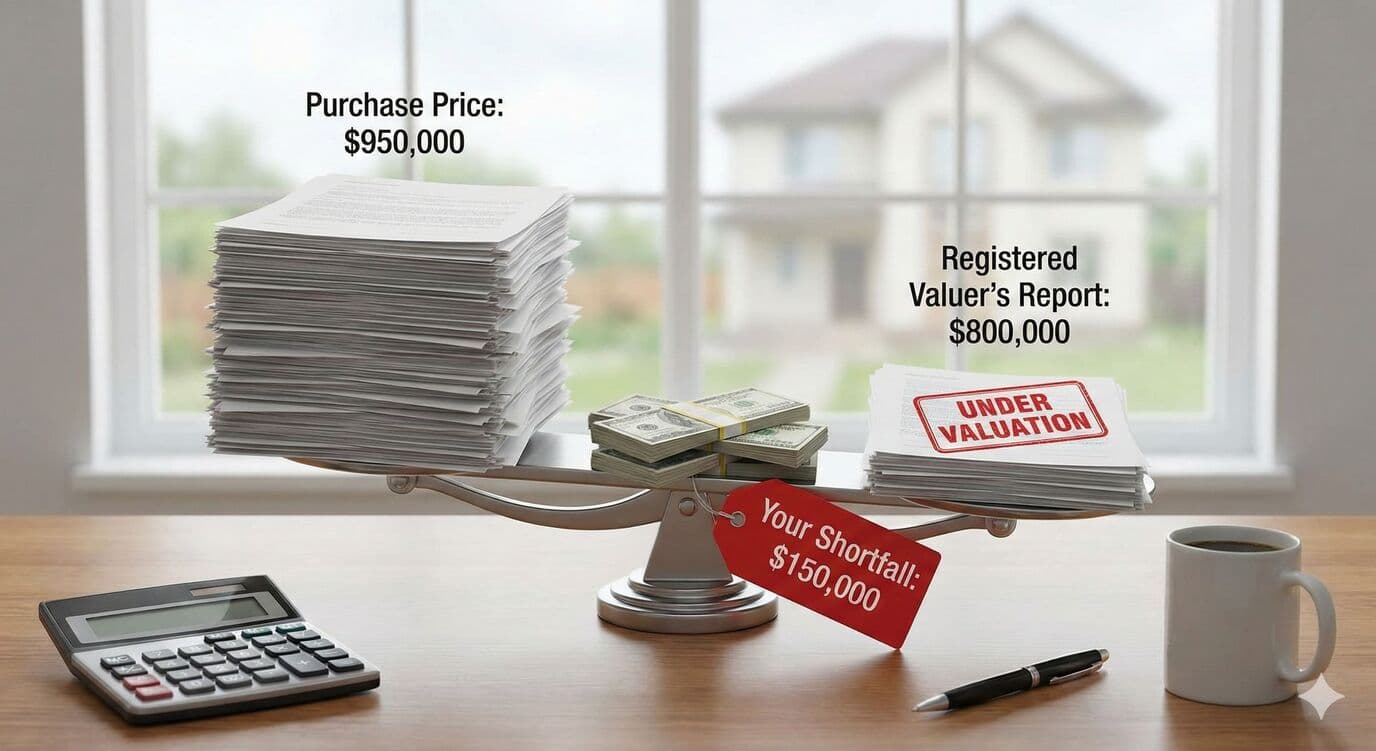
One of the most stressful moments in a property purchase is when the valuation comes back lower than expected. This happens more often than you might think, and understanding how valuations work can help you prepare for, and potentially avoid, this situation.
Why Banks Require Registered Valuations
Banks do not take your word for what a property is worth. They need an independent, professional assessment before lending you money, which protects them from lending more than the property could be sold for if you default. A registered valuer is a qualified professional and member of the New Zealand Institute of Valuers (NZIV) who conducts an independent assessment. Their job is to determine the property's market value, meaning what a willing buyer would pay a willing seller in normal market conditions.
Importantly, the bank uses the valuation figure, not the purchase price, to calculate your loan. If there is a gap between what you are paying and what the valuer says it is worth, you will need to make up the difference yourself.
What Valuers Actually Assess
When a valuer visits a property, they assess multiple factors across three main categories. For property specifics, they examine the land size and contour, building size, age and condition, number of bedrooms and bathrooms, construction materials and quality, any renovations or additions (whether consented or not), and chattels included in the sale.
For location factors, they consider the neighbourhood and street appeal, proximity to amenities, schools and transport, local council zoning and development plans, and natural hazards such as flooding, coastal erosion, and liquefaction zones.
For market comparison, they analyse recent sales of similar properties in the area, current market conditions and trends, and how long comparable properties took to sell. The valuer compiles all of this into a detailed report that includes their market value assessment and often highlights issues the bank should be aware of.
When Valuations Come In Low
A low valuation means the valuer's assessed value is less than your agreed purchase price, which creates a gap that affects your borrowing. For example, if you are purchasing at $850,000 but the valuation comes in at $800,000, you have a $50,000 gap. If you planned for a 20% deposit of $170,000, the bank will only lend 80% of the $800,000 valuation, which is $640,000. You now need $640,000 from the bank plus $210,000 in your own funds to reach the $850,000 purchase price, meaning your effective deposit requirement has increased by $50,000.
This can happen for several reasons. You may have paid a premium in a competitive bidding situation. The property might have unique features with limited comparable sales available. Recent market softening may not have shown up in comparable sales data yet. The property may have issues such as weathertightness concerns or consenting problems that affect its value. Or the valuer may simply be taking a conservative approach in an uncertain market.
Your Options When Valuations Fall Short
If you have additional savings, you can make up the difference by simply increasing your deposit to cover the gap. This is straightforward but requires having cash available.
If you have a valuation condition in your contract, you may be able to renegotiate the price with the vendor. Some vendors will accept a lower price rather than risk the sale falling through, though others will not budge.
You can request a different registered valuer for a second opinion, though you will pay for another valuation at $600 to $1,000 or more. Different valuers can reach different conclusions, particularly for unusual properties. However, if a second valuation comes in similar to the first, you will need to accept that is likely the true market view.
If you have a finance or valuation condition that has not been satisfied, you may be able to walk away from the purchase. This is painful after all the effort of finding a property, but sometimes it is the right call.
In rare cases, you can challenge the valuation by providing the valuer with additional information they may have missed, such as recent comparable sales they did not consider, details about renovations, or corrections to errors in their report. Valuers are professionals, but they are not infallible.
Different Scenarios: How to Protect Yourself
Buying at Auction
Auctions are unconditional, so once the hammer falls you are committed. This makes getting a valuation before auction critical. Order your valuation before auction day, allowing 3 to 5 working days for completion. Know your maximum bid based on the valuation, not just your budget, and factor in a buffer rather than bidding right up to the valuation figure. In a hot auction you might choose to pay above valuation, but go in with your eyes open about what you are doing.
Tender or Deadline Sale
Tenders often request unconditional offers, but you can still include a valuation condition. Your offer may be less attractive to the vendor, but it protects you. Consider including a clause allowing renegotiation if valuation is more than 5 percent below your offer, making your offer subject to finance which gives the bank time to order a valuation, or pre-ordering a valuation if you are serious about the property.
Private Treaty (Negotiated Sale)
Private treaty sales give you the most flexibility. You can include a valuation condition in your offer, make your finance condition long enough for the bank to complete their valuation, negotiate the price if valuation comes in low, and withdraw if you cannot reach agreement with the vendor.
Why Vendor Valuations Do Not Count
Real estate agents sometimes provide vendor-commissioned valuations as marketing material, but these are essentially worthless for mortgage purposes. They are commissioned by someone with a vested interest in a high value, they do not meet banking independence requirements, they may be outdated or based on incomplete information, and banks will always require their own independent valuation. Do not rely on a vendor valuation when determining your offer and get your own independent assessment instead.
Desktop Valuations vs. Full Valuations
For lower-risk situations such as established areas, standard properties, and lower LVRs, banks sometimes use desktop or automated valuations. These use algorithms and recent sales data rather than a physical inspection. Desktop valuations are faster (often same-day), cheaper (or included in bank fees), but only available for lower-risk properties and lending. If your property or situation does not qualify for a desktop valuation, you will need a full registered valuation.
Preparation Beats Surprises
Valuations protect banks, but they also protect you from overpaying. If a valuation comes in low, it is worth understanding why before deciding your next move. Always factor valuation risk into your purchase planning, include appropriate conditions in your contract where possible, order pre-auction valuations for any auction property, do not rely on vendor valuations or online estimates, and talk to your mortgage adviser about contingency plans.
A good mortgage adviser will help you understand your options if a valuation does not go your way and help you structure your purchase to minimise the risk in the first place.
Need Help With Your Mortgage?
Our expert advisers are here to guide you through every step of your mortgage journey. Get in touch for a free, no-obligation consultation.
Talk to an Adviser