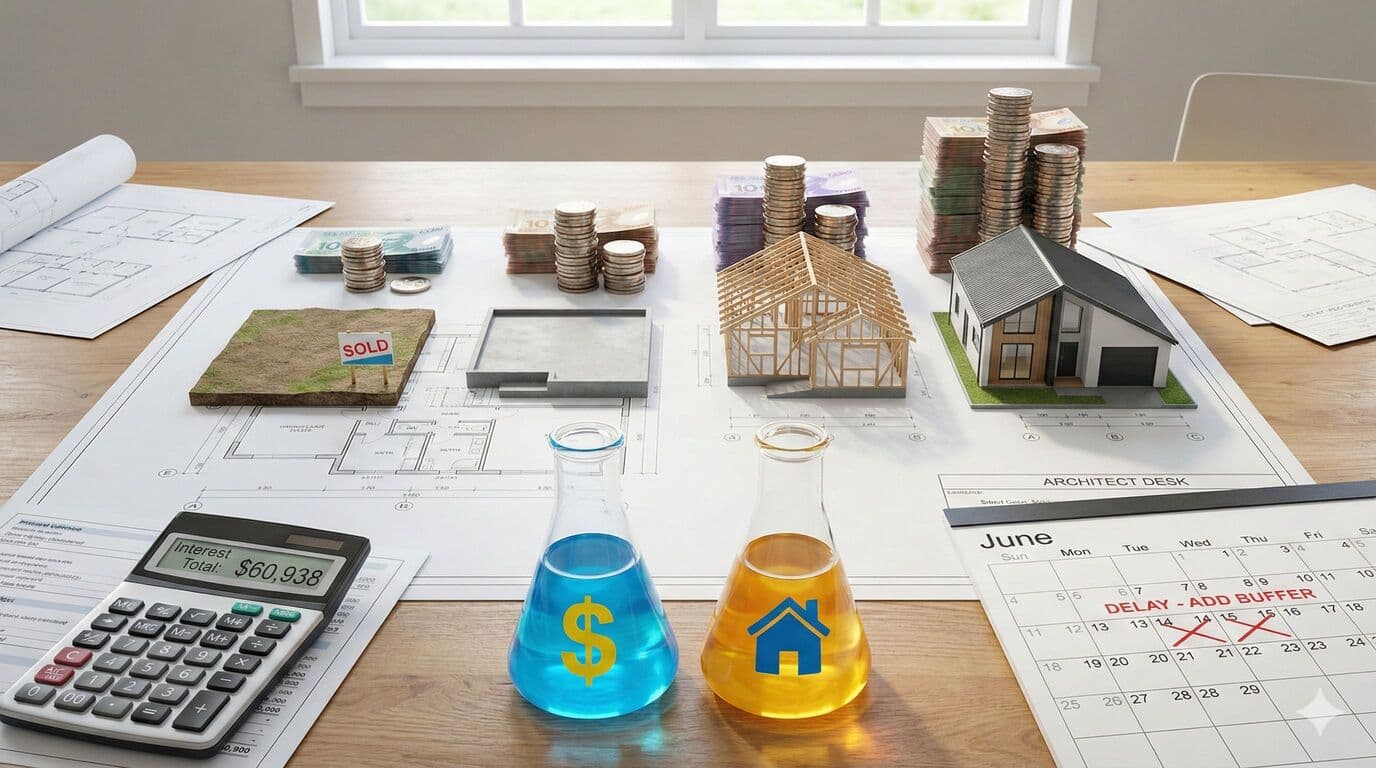
Building a new home is exciting, but the finance side can be confusing, especially when it comes to understanding how much interest you'll pay during construction. If you're using a progress-payment contract (the most common type in New Zealand), this guide will help you budget accurately.
How Progress-Payment Construction Works
Unlike turn-key contracts where the builder finances the entire project and you pay on completion, progress-payment contracts require you to fund the build in stages. The bank releases money to your builder as they complete each construction milestone.
| Stage | Description | Approximate % of Build |
|---|---|---|
| 1 | Deposit (on signing contract) | 5-10% |
| 2 | Foundation complete | 10-15% |
| 3 | Framing complete (roof on) | 20-25% |
| 4 | Closed in (weathertight) | 15-20% |
| 5 | Fit-out complete | 15-20% |
| 6 | Practical completion | 15-20% |
| 7 | Final payment (code compliance) | 5% |
Your mortgage grows with each drawdown, which means your interest payments increase throughout the build.
How Interest Accumulates
Here's where many first-time builders get caught out: interest starts accruing immediately, and it compounds as each payment is drawn down.
From the day you settle on your land, you're paying interest on the full land value. If you bought a $350,000 section, you're paying interest on $350,000 from day one. As each progress payment is released to your builder during construction, that amount is added to your loan balance and your interest payments grow with each drawdown. Once the build is complete, you're paying interest on the full loan amount combining land and build cost.
Calculating Your Interest Costs: A Worked Example
Let's work through a realistic scenario with a land value of $350,000, a build cost of $550,000, a total project of $900,000, an interest rate of 6.5% per annum, and a build duration of 12 months.
For interest on land over 12 months, $350,000 × 6.5% = $22,750 for the year. For interest on the build with staged drawdowns, since drawdowns happen progressively you're not paying interest on the full build cost from day one. A rough estimate is interest on 50% of the build cost for the full period: $550,000 × 50% × 6.5% = $17,875.
The estimated total interest during construction is $22,750 + $17,875 = $40,625.
The Reality Check: Add a Buffer
Construction projects rarely run exactly to schedule. Weather delays from heavy rain, high winds, or frost can halt work. Council inspections may face scheduling delays that add weeks. Material shortages and supply chain issues have become more common. Subcontractor availability is often limited as trades are frequently booked out.
A 12-month build can easily stretch to 15-18 months. Budget at least 50% more than your calculated interest to account for delays. Using our example: $40,625 × 1.5 = $60,938 budget.
Month-by-Month Interest: A Detailed Breakdown
For those who want to model their exact costs, here's how interest accumulates month-by-month:
| Month | Event | Loan Balance | Monthly Interest |
|---|---|---|---|
| 0 | Land settlement | $350,000 | $1,896 |
| 1 | Deposit paid (10%) | $405,000 | $2,194 |
| 3 | Foundation complete | $487,500 | $2,641 |
| 5 | Framing complete | $597,500 | $3,236 |
| 7 | Closed in | $680,000 | $3,683 |
| 9 | Fit-out | $762,500 | $4,130 |
| 11 | Practical completion | $855,000 | $4,631 |
| 12 | Final payment | $900,000 | $4,875 |
This simplified example shows how monthly interest payments roughly double over the build period.
Can You Borrow the Interest?
Yes, if you have enough equity. This is called "capitalising interest" and it's particularly helpful for first-home builders who are still paying rent.
The bank adds an interest provision to your loan, and interest payments during construction come from this provision. You don't need to fund interest from your own pocket during the build. Most banks want 20%+ equity in the project, your loan application must show you can afford the eventual repayments, and the capitalised interest adds to your total loan.
To illustrate: on a total project of $900,000 with estimated interest of $45,000, the loan would be approved for $945,000. You still need the same deposit, but you don't need to fund interest during construction.
This option is worth discussing with your mortgage adviser, especially if managing rent and construction interest simultaneously would stretch your budget.
Turn-Key vs Progress Payment: Which Is Better?
Turn-key contracts have the builder fund the construction, with you paying on completion or at fixed milestones. There's less interest cost during construction, but often a higher contract price to cover the builder's financing. You'll have less flexibility to make changes during the build.
Progress-payment contracts have you funding the build as it progresses. There's more interest cost during construction, but often a lower base contract price. You get more control and flexibility, and can make changes during the build (at a cost).
Neither is universally better - it depends on your cash flow and how involved you want to be in the build process.
Tips for Managing Construction Interest
Lock in your land rate if possible by fixing your land loan portion to avoid rate rises during the build. Time your build strategically, as starting in spring gives maximum good-weather building days before winter. Stay on top of paperwork since delays in council approvals or bank drawdown requests add unnecessary time.
Build in contingency for both interest and unexpected build costs, with 10-15% being typical. Communicate regularly with your builder through site meetings to help identify delays early. Consider interest-only payments during construction for lower payments while building, then switch to principal and interest on completion.
Budget With Your Eyes Open
Understanding construction interest helps you budget realistically. The key formula is: (Land value × interest rate × build time) + (Build cost × 50% × interest rate × build time) × 1.5 = Interest budget.
Talk to your mortgage adviser before signing a building contract. They can model your exact interest costs based on your project timeline and help you structure your loan to minimise costs during the build.
Need Help With Your Mortgage?
Our expert advisers are here to guide you through every step of your mortgage journey. Get in touch for a free, no-obligation consultation.
Talk to an Adviser