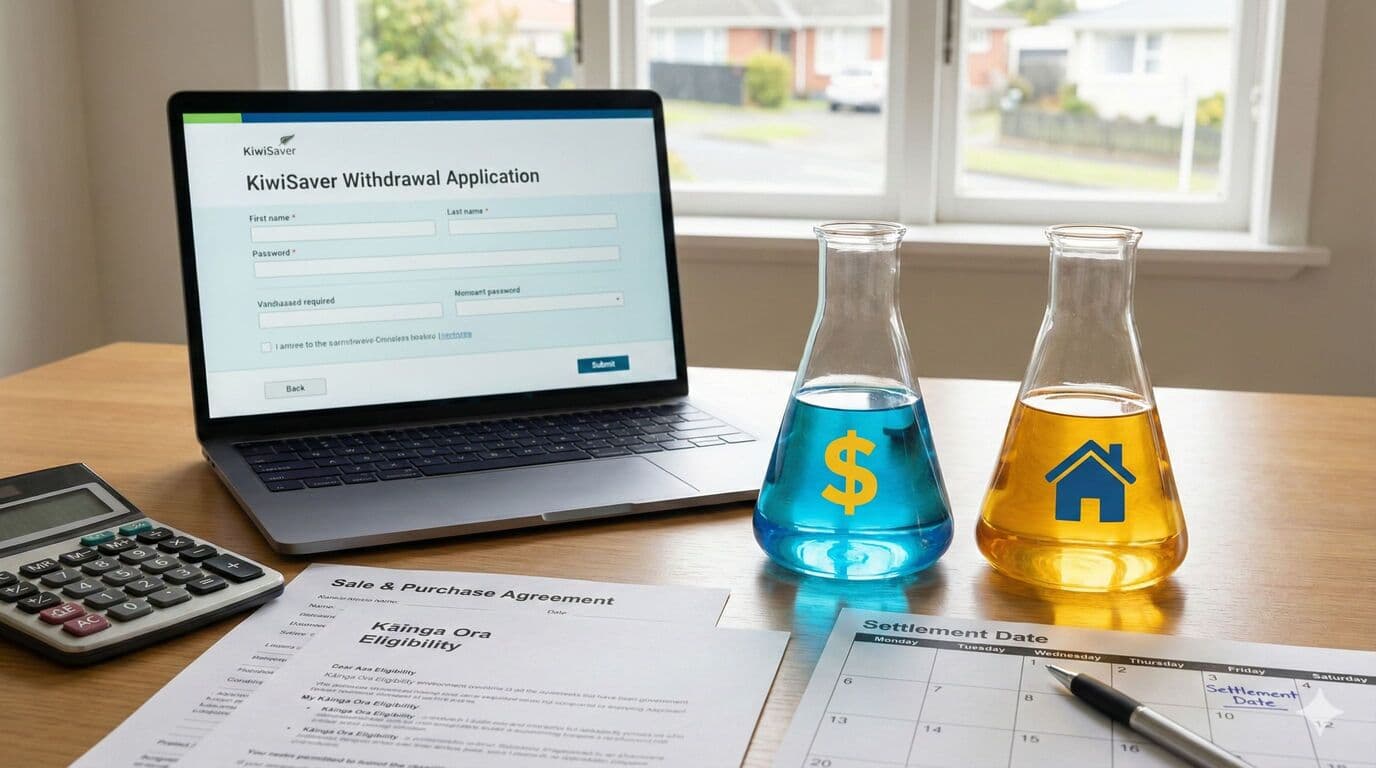
KiwiSaver interacts with mortgage borrowing in several ways. Your balance contributes to your deposit, your contributions affect assessable income, and your investment history demonstrates savings discipline. Understanding these relationships helps you optimise both your KiwiSaver strategy and your mortgage application.
Lenders evaluate your complete financial picture, and KiwiSaver plays a meaningful role in that assessment.
KiwiSaver As Deposit
Your KiwiSaver balance, minus the $1,000 that must remain, can form part of your deposit when buying your first home. This directly affects how much you need to borrow and your loan-to-value ratio.
A $50,000 KiwiSaver balance on a $700,000 property contributes 7 percent of the purchase price. Combined with other savings, this can push you past important thresholds like 10 or 20 percent deposit.
Higher deposits generally mean better interest rates and avoiding low equity premiums. Your KiwiSaver contribution to deposit has direct financial benefits throughout your mortgage term.
Impact On Assessable Income
When calculating your borrowing capacity, lenders assess your income after certain deductions. KiwiSaver contributions are calculated from your gross pay and deducted through payroll. They do not reduce your taxable income like a separate tax deduction, but they do reduce your take-home pay.
Lenders typically use your gross income before KiwiSaver deductions when calculating serviceability. Your KiwiSaver contribution rate does not reduce what they think you can afford to borrow.
However, some lenders may consider your net take-home pay after KiwiSaver when assessing your ability to service the loan alongside existing expenses.
Demonstrating Savings Discipline
A growing KiwiSaver balance demonstrates consistent savings over time. This is positive evidence for lenders assessing your financial responsibility and ability to manage money.
Regular contributions show you can commit to automated savings, which is similar to committing to regular mortgage payments. This supports your creditworthiness assessment.
Lenders also like seeing that you have not withdrawn from savings or made poor financial decisions. A stable, growing KiwiSaver account is a positive indicator.
Contribution Rate Decisions
KiwiSaver contribution choices are now 3.5%, 4%, 6%, 8%, or 10% of your gross salary or wages. Your employer must contribute at least 3.5% from 1 April 2026, before employer superannuation contribution tax. The minimum is scheduled to rise to 4% from 1 April 2028. Higher contribution rates build your deposit faster but reduce your take-home pay.
If you are close to your borrowing limit, reducing your contribution rate to the minimum 3.5%, or applying for a temporary 3% rate reduction if eligible, could increase your assessable income and borrowing capacity. However, you lose the faster deposit growth.
Consider your timeline. If buying is some time away, higher contributions like 6%, 8%, or 10% build more deposit. If buying soon, you might stick with the minimum 3.5% to maximise take-home pay for the serviceability calculation.
Government Contribution
The government contributes 25 cents for every dollar you contribute, up to a maximum of $260.72 per year (if you contribute at least $1,042.86 annually). This is essentially free money that boosts your KiwiSaver balance.
To receive the full government contribution, you need to contribute just over $20 per week. Even if you are not working, making voluntary contributions of $1,042.86 per year ensures you get the maximum government top-up, an effective 25% return before any investment gains.
Using KiwiSaver Early Or Late
Timing your KiwiSaver withdrawal affects your mortgage application. Apply for withdrawal after you have conditional lending approval to avoid any delays at settlement.
Your lender needs to know what deposit you have available. Confirm your KiwiSaver balance and expected withdrawal amount before finalising your loan application.
Processing takes 10-15 working days, so factor this into your settlement timeline. Coordinate with your lawyer to ensure funds arrive when needed.
Investment Property Considerations
KiwiSaver cannot be used for investment properties. If you already own a home and want to buy an investment, your KiwiSaver balance is not available for that purchase.
This makes your first home purchase particularly important. Using KiwiSaver for your first home provides the deposit boost that will not be available for later property purchases.
Your KiwiSaver continues growing for retirement regardless of property purchases. These are separate financial paths that intersect only for first home buying.
Planning Your Approach
Calculate your projected KiwiSaver balance at your target purchase date. Use this to understand what additional savings you need for your desired deposit.
Consider whether increasing contributions now accelerates your timeline. Model different scenarios to see how contribution changes affect both KiwiSaver balance and take-home pay.
Work with a mortgage adviser who can help you optimise the relationship between KiwiSaver, savings, and borrowing capacity for your specific situation.
Need Help With Your KiwiSaver?
Our expert advisers are here to guide you through every step of your KiwiSaver journey. Get in touch for a free, no-obligation consultation.
Talk to an Adviser